Artist

Links and articles
This page will continue to develop as the Bill Gillon archive grows. Over time, it will include exhibition reviews, newspaper and magazine articles, catalogue texts, interviews, and archival material relating to Bill’s life and work. It will also feature links to galleries, collections, art societies, and organisations connected to Bill’s career, together with exhibitions and locations where his paintings are represented or discussed. The intention is to create an evolving resource that helps place Bill’s work within the wider context of Scottish and contemporary figurative painting.
Articles


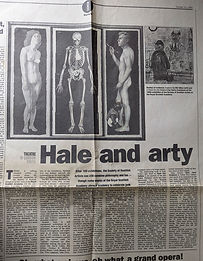
Observer Scotland — Sunday 25 March 1990 “An impressive array of talent as the big one gets off the ground at last” By W. Gordon Smith W. GORDON SMITH is heartened by the Society of Scottish Artists exhibition at the RSA. AT A TIME of great uncertainty about future major Scottish art exhibitions and where they will be hung, the Society of Scottish Artists is in residence at the Royal Scottish Academy and now knows for certain that it will be able to mount its centenary exhibition on Princes Street in October this year. Everything has been in doubt since it became known that the National Galleries of Scotland was discussing plans for the RSA building which would restrict its availability to most of the arts societies who have made it their show place window over the years. And, as happens, essential repair will close the gallery next year. The SSA, second in importance only to the RSA as an association of Scottish painters and sculptors, was forced to activities and confine itself to a show of “works on paper” at the Demarco Gallery, Edinburgh, last November. Then the RSA gallery was made available for the show that opened yesterday and which is, in reality, last year’s annual exhibition. October’s centenary celebration will therefore be the SSA’s third show in a year. Despite these hiccups, the current exhibition is a bright and confident demonstration of the healthy state of the visual arts in Scotland. It breaks new ground by embracing a video installation by the pioneering Centre for Video Art Computing at the Duncan of Jordanstone College of Art, Dundee. There are no fewer than 212 exhibits in four of the gallery’s salons, with sculpture and colourful constructions taking up every inch of available floor space and making an impressive display of creative energy and innovation. If it is true that recent SSA shows feature fewer works by established Scottish painters — there was a time when not many academicians would have missed the chance of being represented, and the work on the walls is less predictable, and of course more space is available for emerging talent. One of the most moving and aesthetically satisfying exhibits this year is Innocence/Remains, Spring 1942, a memorial to the revolutionary dead by the Romanian architect Vasile Töch, who, with René Mönika, have become members of the SSA during their time in Scotland. Töch’s work begins on the floor of the gallery — a thicket of small tree branches decorated with and surrounded by tiny portraits. The eye is led onward and upward to a canvas on the wall, a another symbolic of death, loss and decline, many of them bleached out and faceless. It is a sombre and compelling requiem, suggestive of graveyards, icons and burnt-out churches, a moody presence. Monica Töch contributes Deep Dream, a delightful collage of whimsical but sprightly figures, hung like a parchment scroll. Another outstanding painting is Bill Gillon’s Memory Trace, a large composition binding together the images of two naked females, almost life size, one full frontal, the other in profile, meticulously realistic, rendered in monochromatic sepia and greys. A self-portrait dominates the central space between them. The edges are balanced by two skulls — horse and man — and the palms of two human hands. Like all of Gillon’s work it has disturbing, inexplicably sinister overtones. He has always been one of our great painterly craftsmen, an unrepentant classicist; he goes on plundering his own psyche and visiting the underworld reaches of his mind. It is this time we are more of him in a major retrospective. We see his superb and believable, but the veined sculpture by Hasiong Schafer, particularly his geodesic Sphere — almost six feet in diameter — made up of dinner plates held together by super-glued clothes pegs, challenges that assumption. It is an amazing feat of mechanics and legerdemain, a combination of infinitely pleasing symmetry and huge detail. I also admired (for the second time, I think) Lys Hansen’s raw and primitively powerful Katrine and the Beast; the perky poised menace of cats among pigeons in Gordon K. Mitchell’s Tormentare; two delicate and evocative Asian studies by Mari Bond; John Johnstone’s clever caper If the Blind Lead the Blind; lustrous rak pots by Dave Cohen; Stan Bonnar’s stunning little sculpture of a faceless man; winter collection, Alex Nisbet’s Fruit de Mare; Rob Mulholland’s allegory in space and time, Let it be Known; Fiona C. Danskin’s broody invention, Imaginary Flight; Joseph Dale’s massive triptych of bombers over an industrial wasteland, another Small Day Crept Apologetically By; and the extraordinary ritual performed by literally hundreds of tiny animals in Valérie Anderson’s Bull Dance II. Having spent too much uncomfortable time in that God-forsaken part of the world I was intrigued by the subtle distinctions between Roy Wood’s vision of Tigris and its companion piece Euphrates — and still doubt the word of the Church of Scotland minister who, leading me to the point at which these two great rivers converge, told me I stood on the site of the Garden of Eden. The silly man was obviously oblivious to the claims of Benbecula. There are many other intriguing works in this show: Laura May Morris’s Bathers with its echoes of Gauguin; the intense miniatures by Lesley Bathgate; Jane MacAllister’s pretty icons; the wit of Sylvia von Hartmann’s Unscent Postcards; Aidan Bremner’s ultimate detergent — if he’ll excuse the pun — Flash; Jim Pattison’s sonorous abstract, Violin; Peter McLaren’s continuing odyssey with people hurtling towards some pop-art destiny; Donald Clark’s Ardroi, a symphony of driftwood, rusty metal, old rope and such a sense of an ebbing tide you can almost smell the seaweed.


“Caught in a dream” By W. Gordon Smith (Visual Arts review) Five solo exhibitions since 1965 might indicate a low work-rate. But with Bill Gillon, nothing is what it appears, writes W Gordon Smith THE names of the Scots in the forefront of the surrealist movement — James Cowie, William Crosbie, Alan Davie and Eduardo Paolozzi — could almost be counted on the fingers of one hand. Yet, despite the low profile, there has always been a strong undercurrent of fantasy and irrationality in Scottish painting. Bill Gillon looks as if he belongs in the dream world but in fact is one of the most hard working, prolific and dedicated painters in Scotland — a stylist who has developed a unique and astonishing visual language over the years, full of allusions and metaphors. He seems to spend an inordinate amount of time and energy producing huge, complex and mysterious paintings which challenge our assumptions about what art is for and how we are meant to respond to it. Despite the flamboyant and almost hallucinogenic imagery in his work, his figures appear unnervingly real and plausible. Yet the longer one looks at them the more eerie and disturbing they become, and the more one realises how difficult it is to define the essential meaning and difference between fantasy and reality. His paintings are probably nightmares recalled with extraordinary vividness. There is no doubt he is possessed by strange visions and symbols. Yet there will be only his fifth solo exhibition in over 30 years, when a large retrospective opens at the Edinburgh College of Art in 1965. Another, in 1979, was at the Third Eye Centre in Glasgow. Gillon’s canvases crowd in out of his imagination like a dream. One can almost overlap the images without disturbing the carefully contrived compositions. He does not simply juxtapose bizarre elements and expect us to be shocked. It is as if his entire world-view depends upon maintaining a balance between illusion and reality. Gillon has won his share of prizes throughout a career which spans the years from 1959 to the present. One of the more surprising things about him is that despite the many mixed exhibitions he has been invited to, he has never become part of any recognisable Scottish “movement” or group. Yet his paintings have exerted strong influence on generations of younger painters. At times he has seemed almost like an outsider and innovator, and his success has always been due to the power of his vision rather than to Scotland’s art schools. One of the most extraordinary paintings in the exhibition is Mural Tale — an immense triptych which has been built up over many years. It is a vast and complex allegory, featuring a bizarre collection of human and animal forms, half-human creatures, strange birds, painted “masks” and scraps of paper, all apparently floating in some undefined and timeless space. At first sight the work appears chaotic and irrational. Yet careful scrutiny reveals an astonishing degree of control and organisation. Gillon is obsessed by anatomy, by the texture of flesh, by the vulnerability of the human body and by the symbolism of gesture. The paintings seem to exist in a strange theatrical world where the figures perform elaborate rituals. There is a tendency in contemporary painting toward irony and detachment, but Gillon remains passionately committed to the idea that painting can still deal with profound emotional and psychological states. His work is frequently disturbing because it forces us to confront fears and desires which are usually hidden beneath the surface of ordinary life. Fantasy figures: Bill Gillon’s flamboyant visual vocabulary at work in Mural Tale, on show from April 30 at the left Gallery. The exhibition can be seen as a kind of personal mythology. It contains references to classical art, Renaissance painting, Surrealism and symbolism, but these influences are absorbed into a highly individual style. Gillon’s art is theatrical, literary and intensely visual. The scale of some of the paintings is overwhelming. Their impact depends not only upon technical skill but upon the artist’s ability to create an atmosphere of tension and unease. Even the apparently calm and beautiful figures possess a latent menace. Gillon’s vision is uncompromising. He does not attempt to flatter the viewer or to make his imagery easily accessible. Instead he demands patience and close attention. The rewards for doing so are considerable, because beneath the surface strangeness lies an artist of unusual intelligence and emotional depth. From April 30 to May 11 at the Left Gallery, Edinburgh.
FIGURATIVE PAINTING AS 'THE KEY TO OUR ARTISTIC FUTURE' By Alan Bold I BELIEVE that if the modern artist reincarnates public indifference to art then he has no right to exhibit his work. When he does he only confirms what the public suspects: that most modern art speaks a private language. If a work is meant only for the self-gratification of the artist then the public has a right to leave it to its own devices. So when I got the chance to organise an exhibition of painting in Edinburgh's big Fruit Market Gallery I decided to concentrate on painters who had something to say. For three summer weeks from July 19 to August 9, I want the public to form a judgement on an exhibition by four young Scottish figurative painters. They are Bill Gillon and Alexander Moffat, from Edinburgh; Port Seton-born John Bellany and Neil Dallas Brown, from Elgin. Although they are all in their 30s I think they hold the key to Scotland's artistic future. One of my reasons for saying this is precisely because the general public rather than the gallery-going minority will be able to make contact with their art. For figurative painting sets up a visual dialogue between painter and spectator. It uses recognisable images and the public can watch the artist transform reality into a personal imaginative vision. Each of the four painters is an individual able to stand on his own artistic feet without the need for an ism to cling onto. In fact the one certain thing they have in common is their nationality. It is surprising that four such powerful painters should have come out of Scotland, for visually we missed out on the Renaissance. Believing visual images to be idolatrous the Reformers set up a taboo against them. The sixteenth-century Pope, Gregory the Great, said: "Painting can do for the illiterate what writing does for those who can read." Scotland's sixteenth-century anti-Pope, John Knox, was determined to eliminate illiteracy so the population would base their lives on the letter of biblical law. As a result we developed a verbal, not a visual, culture, and our great men are men of the word: Hume, Burns, Scott, Stevenson, MacDiarmid. When the Scottish Court moved to London in 1603 that effectively removed the prime source of artistic patronage. Scotland has always been keen on exporting things: its tung to England, its population and its national drink to the rest of the world. What these four painters have done is to reverse this trend. They have imported a style, the international figurative language of painting. During the Renaissance, far from Scotland, artists perfected a figurative language based on the science of perspective, the craft of modelling, and the art of illusionist space. This language was fractured in 1907 by the pointlessness of reducing a painting to the sum of its two dimensions. Art went back to pre-Renaissance primitivism and this led to a deliberate atrophy of skill. Many twentieth-century artists became visually illiterate. Lacking technical expertise they were at the mercy of their emotions. However, in Central and Northern Europe there was a revival of figurative skill by painters intent on making emotionally significant statements. Painters like Max Beckmann in Germany, Fernand Léger in France and Edvard Munch in Norway. James Ensor in Belgium. They showed, too, that figurative painting does not mean producing a pretty picture. It means having first the ability to reproduce external world – the courage of one's craftsmanship – and then the capacity to transform the world into a personal vision. Bellany, Dallas Brown, Gillon and Moffat are all artistic importers, and acknowledge a stylistic debt to these modern European figurative masters. But though they speak the international figurative language they do so with a Scottish accent. If Scottishness has a distinct flavour, it surely lies in the empirical desire to test imagination against experience. The work of these four painters is rooted in the reality of their own experience. Bellany, the son of a boat-builder, paints the squalor of the present beside the timelessness of the sea, man's original element. Bill Gillon, who grew up in Leith, indicates the urban nightmare: man threatened by machines. Dallas Brown, who works in Dundee but feels more at home in the coastal quiet of Newport-on-Tay, invokes psychological pressure in a personal tragedy. Moffat, haunted by a personal tragedy, portrays aspects of nocturnal Edinburgh conscious of the absence of his elder brother John, who was killed in 1973. If Scottish art is to develop, I believe it must do so on such figurative lines. The schools of painting we have seen in Scotland – the Scottish Colourists of the 1920s, the J.D. Fergusson-inspired New Scottish Group of the 1940s – lacked emotional conviction. The painters submitted to sensation; they were not confident enough to make artistically autonomous statements out of their relationship with nature. The human figure will continue to be the most potent visual metaphor available to the painter only if the painter is in control, in command of his creativity. He must not slavishly copy the world but instead interpret it individually. I think that these four painters do this.
